Worst Wordle Starting Words and What to Try Instead
Understand why the worst Wordle starting words offer limited clues, what XYLYL's reputation means, and how RAISE compares with ADIEU and AUDIO.
- Starting Words
- Repeated Letters
On this page
In the 2022 game of Wordle, the word XYLYL was reported as being the worst opener in two analyses. In Rob Miller’s ordering of openers, it came first, followed by IMMIX, JUGUM, HYPHY, OXBOW, etc. Chris’s revised calculations took into account both letter frequency and position, using sums and products, but the reports don’t establish XYLYL’s exact revised ranking or its margin.
Why opener rankings differ
These historical findings are rather different from what I’m seeing now, when I calculate the effectiveness of various starting words based on their ability to narrow down the possible answers. The current ranking of openers is different than what was found in the past, and I don’t think there’s a verified current ranking for Wordle either (I’ve heard that some people use an automated guesser, but I don’t know whether they’re able to accept guesses from users).
But I can’t attribute the difference between the old rankings and the new ones to answer-pool size: the reports don’t establish that the historical pools were smaller. In my analysis, I considered all 2,765 common answer words in this site’s pool. Also, I calculated the number of bits of information each opener gives us, whereas Chris’s historical calculations used letter frequency and, in revised versions, position. Average answers remaining and the size of the largest group of possible answers are separate metrics reported by this site. So we can’t really say that one method is better than another — each has its own merits, and the rankings produced by different methods may not be interchangeable.
What this means is that if you want to find the best opener for Wordle right now, you’ll have to look at the rankings that are currently available. But since these rankings are based on limited information, you might want to double-check them against your own experience playing the game.
What makes an opener less helpful
The biggest issue with any opener is that it doesn’t cover enough letters. This makes it harder to figure out what the correct answer is, because the feedback you get from the tiles won’t tell you much about which letters are present. Repetition is judged by how well its feedback separates the possible answers — XYLYL has three distinct letters across five positions, but repeated Y and L. It also includes X, which isn’t in most other answers. Duplicate letters and letters that appear in few remaining words tend to push toward the less helpful end of Ostermiller’s helper ordering. Each candidate played against 2,765 common answer words, and identical feedback colors grouped the answers together. The first-row feedback identifies the group containing the answer, and strong openers will leave many small feedback groups. Repetition alone isn’t sufficient to determine the universal ranking of openers.
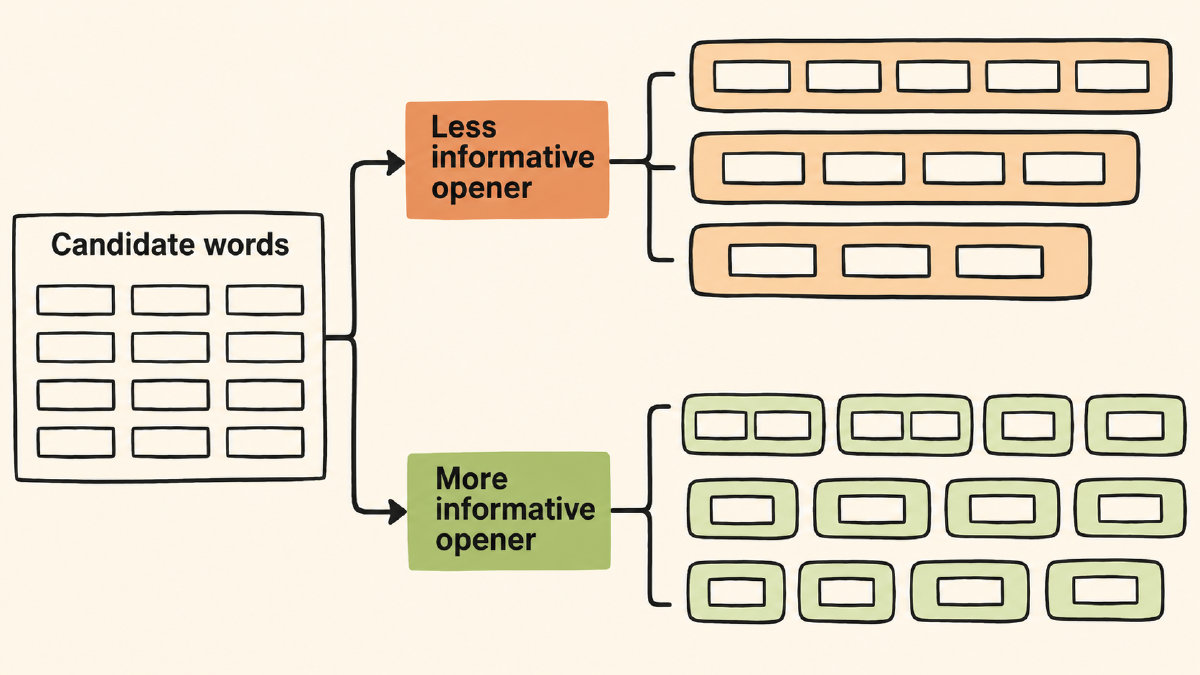
Ranking methods differ by explaining bits as expected information, average answers remaining as expected group size, color patterns as the number of groups, and worst case as the largest group. Historical letter-frequency and position calculations; this site’s feedback analysis: 2,765 common answer words; this site’s ranking measure: expected information in bits; largest remaining group: usually the all-gray result; word pool and scoring method determine the comparison; bits, average answers remaining and largest group: separate metrics with noninterchangeable orderings.
Alternatives to ADIEU and AUDIO
If you’re looking for alternatives to the vowel-heavy openers like ADIEU and AUDIO, RAISE is a supported alternative. On average, RAISE leaves about 74 answers left, which is better than ADIEU’s 145 and AUDIO’s 216. CRANE leaves about 100 answers left. While ADIEU and AUDIO are weaker than RAISE on this metric, none of these openers has been designated as the absolute-worst opener. If you want to score your preferred opener, you can use the starting-word scoring tool.
When choosing the next guess after the initial opener, it’s important to preserve the different information carried by colored and extra gray copies of a repeated letter. For example, if your guess has one green or yellow copy of a letter and an extra gray copy, the answer has exactly one copy of that letter. When you enter your next guess, mark each tile with the feedback actually received for that row. You can do this by using the solver’s suggestion for the next guess, or by entering your guesses and tapping the tiles to match received colors. Each green or yellow tile represents one answer copy used, while extra guessed copies will turn gray. Green or yellow copy alongside an extra gray copy indicates a clue about a repeated letter. The documented solver workflow is to enter your guess, tap its tiles to match the received colors, and choose your next word using the updated possible-answer count and top three guesses. There’s no tested recovery sequence or guarantee of success.
Sources
Try it yourself
Free, in your browser. Nothing you type is uploaded.
More in Wordle Strategy
- Has Wordle Ever Repeated a Word? Yes—Past Answers Can ReturnHas Wordle ever repeated a word? Yes. Learn about answer reuse since February 2026 and why past answers can still fit your current clues.
- How to Approach the Hardest Wordle Words in Standard ModeApproach the hardest Wordle words in standard mode by tracking repeats, spotting lookalike patterns and using tile clues to choose your next guess.