How to Approach the Hardest Wordle Words in Standard Mode
Approach the hardest Wordle words in standard mode by tracking repeats, spotting lookalike patterns and using tile clues to choose your next guess.
- Difficult Word Patterns
- Repeated Letters
- Guess Selection
On this page
Wordle's difficulty rankings give you a sense of what kinds of patterns will be most challenging, without necessarily establishing a definitive list of the hardest words. CNET describes a study based on Google search interest for hints. WordFinder5Letters says its historical puzzle table is ranked by failure rate, and separately describes a predictive difficulty model. Those aren’t all measuring the same thing.
Repeated letters and tile feedback
Five-letter words need not contain five distinct letters. Some repeated vowels and consonants are simply more familiar than others — or just seem to occur together too often to be useful as guesses. Others aren’t part of your vocabulary at all. The site's inventory includes five-letter words with Y as the only vowel, for example. You can try treating these as possibilities to reconsider, rather than as automatic indicators of difficulty.
Each green or yellow tile accounts for one answer-letter copy. That means surplus guessed copies (e.g., if you think there’s only one P in the word, and guess APPLE) may end up being gray. If you do know there’s a repeat (e.g., the answer is PAPER), however, you’ll want to make sure your guess preserves the surviving copy of the letter.
Let’s say that, as a hypothetical, you’ve tried PLANT as your first guess and got back a P and an A in the right place, but the other three tiles turned out gray. The next guess would probably involve guessing some word with those two letters, such as APPLE. Let’s suppose that guess gives you a yellow A, a yellow P at position 2, and gray tiles for the second P, L and E.
If that were the case, you’d have exactly one P in your answer: one yellow P and one gray P tell you that the second copy is surplus. The yellow P is in the wrong position; the green P from PLANT still fixes P at position 1.
That said, it’s possible that one P might still remain, but position 2 (where the first P appears) would then be excluded from consideration. As an illustration, I created this hypothetical scenario: I guessed APPLE against PLANT. The feedback resulted in a yellow tile for the P at position 2 (the first P) and a gray tile for the P at position 3 (the second P). One P has survived, meaning the other was incorrect; position 2 is now excluded for P.
Narrowing the remaining candidates
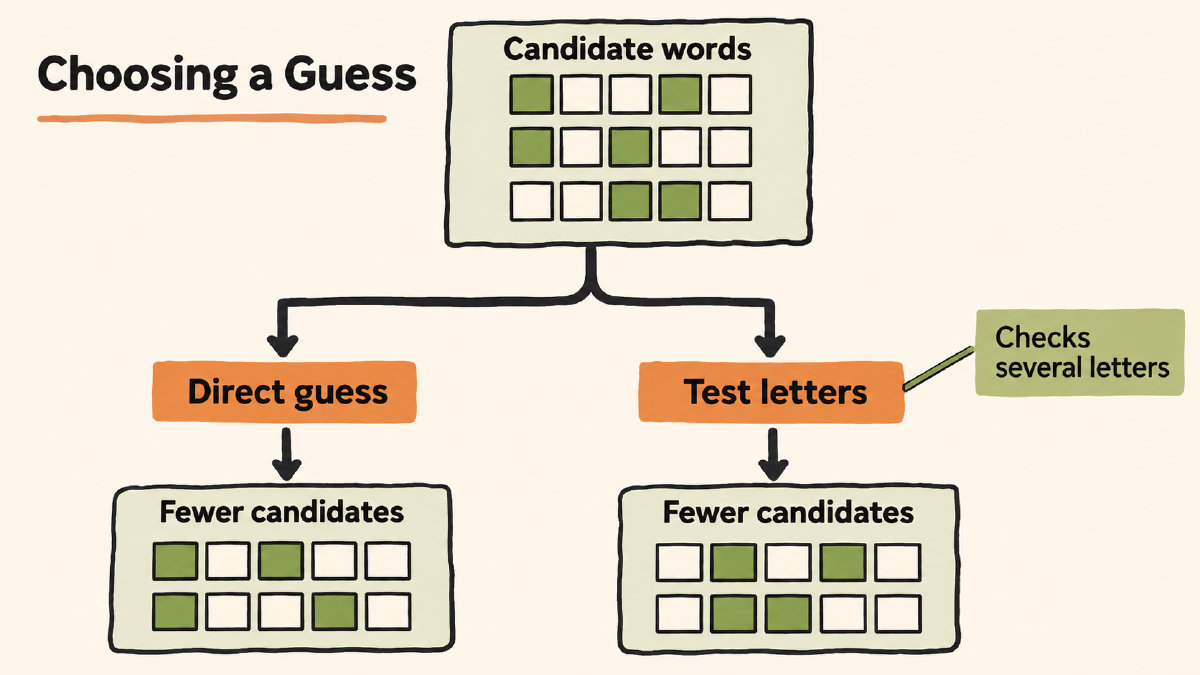
As a separate hypothetical example, suppose we’ve narrowed the options down to four positions where the letters are known, leaving us with a choice between four possible candidates.
In our example, let’s assume the answer is one of the following:
PAPER
PAVER
PAYER
PARER
That means the third letter is unknown. Which letters are left? P, V, Y, R. There’s a lot to consider here, even when the prior feedback didn’t help narrow the options down. For example, if the feedback hadn’t indicated anything about the fourth and fifth letters, then it wouldn’t have eliminated any of these four choices. We’d still need to test them individually to see which one fits.
Choosing a probe with guesses remaining
It also means that each turn we spend trying to identify a possible answer is worth less and less. That’s why the value of a probe depends on how many turns you still have remaining. What information it reveals can distinguish between two remaining answers? Or will it merely eliminate the possibility that one is correct?
For a five-letter word, Wordle offers six guesses, with only one turn spent identifying a final answer. That means there are plenty of opportunities to gather information. When faced with a shortlist like this, choosing the right answer isn’t always an easy decision.
IVORY would be a good choice to test, because that’s an unusual combination of vowels and consonants. Suppose both the V and Y in IVORY turned out to be gray. Then you know that PAVER and PAYER are ruled out, leaving PAPER and PARER, which contain neither V nor Y. Since you still have a couple of guesses remaining, you’ll want to pick one of them and act accordingly.
But what if you had only one guess left? That’s when an information-only guess becomes far less valuable. Without another chance to figure out what went wrong, you won’t have the opportunity to try a different strategy. Instead, you’re likely to be forced to guess blindly.
Using the Wordle Solver helper
I’ve previously outlined the process the Wordle Solver helper uses to suggest a possible next-guess word. Essentially, you can type in your existing guesses, and tap on the tiles that match the actual feedback. Repeated letters should be preserved as mixed yellow, green and gray tiles exactly as they were returned.
The homepage promises that a “next-guess” suggestion will appear, based on whatever clues you’ve already gathered. It may not lead directly to the solution, but it can serve as a useful starting point to compare to the unresolved differences among your remaining candidate words.
Sources
Try it yourself
Free, in your browser. Nothing you type is uploaded.
More in Wordle Strategy
- Worst Wordle Starting Words and What to Try InsteadUnderstand why the worst Wordle starting words offer limited clues, what XYLYL's reputation means, and how RAISE compares with ADIEU and AUDIO.
- Has Wordle Ever Repeated a Word? Yes—Past Answers Can ReturnHas Wordle ever repeated a word? Yes. Learn about answer reuse since February 2026 and why past answers can still fit your current clues.